

Is AI Driving PR Into Its Slop Era?
Is AI Driving PR Into Its Slop Era?
Along the lines of AI causing seismic shifts in our industry, I’ve read the think pieces about its ethics, economics and environmental impact, but that’s a column for another day.
I’ve also been reading a lot of generic, poor-quality writing recently. I mean, why is every Linkedin post like that? Why are brand sites sounding the same? Why does my inner monologue suddenly have a cadence that lists everything in threes? In an industry that’s all about language, I keep asking myself: what happens when a large language model starts speaking for us?
Part of me fears AI might be pushing PR into its Slop Era, one full of mediocre quality full of tired, generative tropes: Bloated lists, identical sentence structures, overuse of em dashes and Oxford comma, standardizing then sterilizing the subtle art of professional communication. Or worse, the fake citations and hallucinated quotes often spat out by these LLMs (remember, they’re not a search engine), degrading the integrity and credibility of the field.
“Whether its the lists, sentence structure, or over-use of em dashes and oxford commas — or worse, the hallucinations and fake citations ChatGPT can often spit out — these LLMs have been producing a lot of the same thing.”
Thanks, Chat. Could have (and did) say it better myself.
This is not a slam-piece on AI. Like any innovation, it has massive upsides (AI & GEO reporting is pretty cool! ). I worry about what the misuse of a nuanced tool could mean.
I had the honor of taking an entire class in grad school on Generative AI and the media with the incredible Nicholas Diakopoulos. His research alongside Hannes Cools has highlighted the importance of AI literacy, noting that journalists have similar fears: AI oversimplifying nuance, misrepresenting information (via hallucinations and bias), or potentially dulling the very critical thinking that makes our work human.
Creativity and real engagement with material matter, especially in media. Do I expect every client or brand to fully get that? No. But somewhere in the earned media chain from brand copy > pitch > publication, there ought to be journalistic autonomy and actual human effort.
I seem to share this sentiment with some media across the pond as well, the Press Gazette noted that journalists are bombarded by a wave of AI-generated slop sent by PR pros who were handed slop to begin with.
I get it: a CEO shouldn’t be their own spokesperson, and maybe they shouldn’t write their own bio. But outsourcing personal details to ChatGPT (which, I cannot stress enough, is not Google) is… bleak. If every link in the earned-media chain gets diluted by AI mush, quality nosedives. From the internal comms/marketing, to the PRos, to journalists, then readers, then eventually the next generation. Suddenly nobody can write a sentence without four em dashes, we are all delving all the time, then nobody can write a sentence full stop.
Yes, slippery slope. And yes, I’m doubling down.
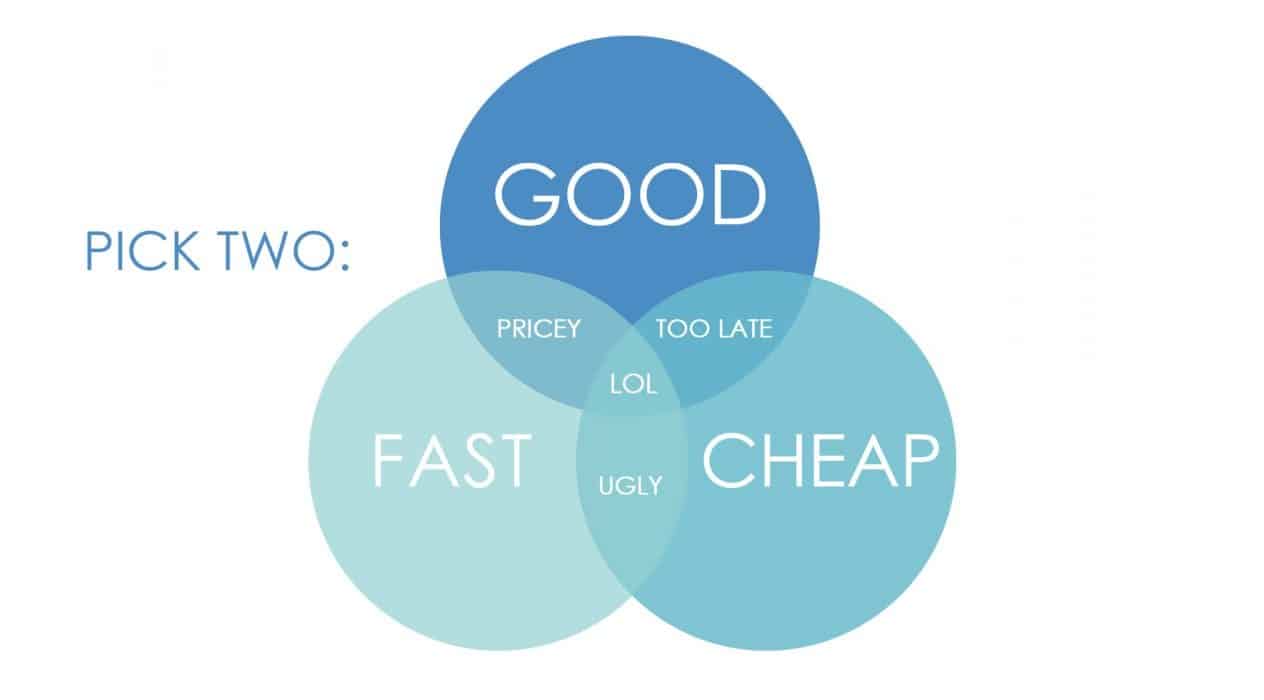
See the figure above. I have been told that with most things, we only get to pick two. And if the thing we’re cheapening is the mind and our ability to think, write or communicate, I worry that cutting out “good” means we’re stunting ourselves.
There’s a balance here, tech and innovation can support the work without sacrificing skill for convenience. I am ten-toes-down on speaking and thinking for ourselves.
But as more and more people, more and more executives turn to AI for seemingly everything: advice, contracts, captions, even pitches, I worry that a good pitch is going to become a needle in a slop bucket.
What do you think? This is for sure my hottest most timely take yet. Standing on business.
Chat soon,
Sarah