Category: Industry Baby

  • From Escapism to Experience: Live Events are So Back

    From Escapism to Experience: Live Events are So Back

    In theory, a brand trip is a great idea. A bunch of camera-ready personalities, generating a triple whammy of creator-brand longevity, brand buzz, oh, and a ton of content, all together on a lush adventure, earning an influencer right of passage on the corporate credit card? Sign me up! 

    In practice, they make my PR brain very nervous. Anyone who lived through Dramageddon or the infamous Tarte trip knows that brand trips have had a tumultuous past and are heading toward an even more uncertain future. As recent as Coachella ‘26, influencers “sell out” to live lavishly with brands they once condemned online to mass backlash

    On my nightly LinkedIn lurk, I came across this article from Jasmine Enberg and Kaya Yurieff from Scalable Pod (IG: @scalablepod) on these exact thoughts, with a focus on a new, potentially major player in creator marketing: the live event. Immediately, I knew I had to slide into some DMs. Extending a big, huge ‘thank you’ to Jasmine for sharing her thoughts: 

    Given the history of controversy and risks with brand trips, why do you think brands still lean into them?

    “For some brands, trips make a lot of sense. Take airlines and hotels, for example: Their businesses revolve around travel, so taking creators on a trip is a natural way to promote their brands.

    Trips are also still a way for brands to generate buzz, creator loyalty and get a ton of social content at a relatively low cost. It’s often cheaper to fly a bunch of creators and influencers to an exotic location where you know they’re going to film a ton of content than to negotiate individual brand deals with multiple creators.

    The problem is that these trips often get the wrong kind of attention. They’ve gotten more and more extravagant over the years, which has rubbed people the wrong way. Especially when people’s budgets are tight, trips can seem out of touch. 

    It also just gets old: There’s only so much content people can take on anything.

    Plus, brands also have less control than they might think over what creators post from those trips. And the ripple effect is real: Shein’s disastrous trip in 2023 also reignited other concerns about its business practices.”

    That’s the crux of it: the lack of control. In today’s landscape, lack of control over public perception and creator content is a risk that is harder to justify than ever. As recently as a few weeks ago during Coachella, feeds were flooded with backlash and discourse around brands like Starbucks and their heavy-handed presence at the festival. 

    “Selling out” and becoming “unrelatable” are critiques as old as time, but the stakes feel higher now. What was once a symbol of influencer status is increasingly viewed as tone-deaf, or worse, reputationally catastrophic. Consumers are more discerning, more vocal, and more skeptical.

    But, as they say, when one app closes, another one opens. The brand trip may be losing its shine, but a new model for experiential marketing is gaining traction: the live event.

    What makes a live brand event successful (or more effective than a brand trip?)

    “Live events give brands many of the same benefits (meaning buzz, loyalty and social content) as influencer trips, with much better optics and more control.

    For brands, live events are a way to bring people into their world in a more controlled environment, while still letting creators share their own stories. They can also open these events up to the public, so people don’t feel excluded.

    They can also be logistically easier and cheaper to coordinate, especially when brands don’t have to fly a group of creators somewhere—and if they were planning to host an event anyway.” 

    Do you see this as a lasting shift?

    “It’s certainly not just a fad. Live events are so back. People genuinely want to be in-person again. You see that everywhere, with Gen Zers returning to malls and even campuses opening up for creators (whose entire careers have been digital) to co-work.

    The catch is that people also want their offline experiences to reflect what they’re experiencing online. They don’t want the malls of the 90s, they want experiences that are made for the modern age. Creators are a big part of that. 

    That’s also why you see podcasters going on tour and some creators even opening theme parks!”

    I’ll admit, I’m a bit biased. I got my start in PR helping local bands (including my own) plan and promote live concerts and festivals. I’ve seen firsthand the kind of connection that only happens in person. Events are lit. 

    And as a Gen Z, that desire for connection feels stronger than ever. Authenticity is a value and baseline that my generation and beyond demands (peep last month’s piece on celebrity brands and perceived authenticity). That fine line brands and creators dance between relatability and “selling out” isn’t going anywhere; there’s just something more honest about an experience that’s meant to be branded, especially when it invites people in, rather than shutting them out.

    Brands creating connections will fare better over those creating content. Where the standard of brand trips is reminiscent of past trends, the artifice of content and aspiration, the new standard and best practices will become about access. And the brands that understand the difference will be the ones that can get away with creator-brand longevity, buzz on the cheap, oh, and a ton of content once again. 

    Brand trips walked so live events could run. For Gen Z and beyond, consumers are going to be more interested in what’s happening IRL than who got flown to Tulum.

  • Hype & Holdings: The New Era of Celebrity Endorsements

    Hype & Holdings: The New Era of Celebrity Endorsements

    In the past decade or so, it feels like every celebrity had a beauty brand, then a tequila brand, now a non-alcoholic adaptogenic botanical elixir (electrolytes optional). We move fast here.

    The Olympian on the Wheaties box or LeBron’s Sprite Cranberry cans (formative for my generation) feels like a thing of the past. Instead of hearing “[Celeb Name] for [Brand],” we’re hearing “[Brand] from [Celeb Name]” much more often.

    So is the celebrity endorsement dead? Or did it just get promoted?

    We were shook when we found out Alix Earle made a controversial $1M off a busted Gymshark deal. But Selena Gomez becoming a literal billionaire from Rare Beauty? (the same fate most likely facing Earle as well with her expertly-marketed upcoming skincare brand) That’s business, baby! Public favor upheld. 

    Part of this shift feels inevitable. Relevance cycles are ruthless now. If public favor turns on Sprite, LeBron feels it and vice versa. Taylor Swift famously avoids traditional endorsements for this reason. When partnerships are risky and attention spans are short, ownership can function as insulation… or at least a faster path to cashing out.

    Technology and social media have also shrunk the distance between celebrity and consumer. Parasocial relationships have created massive purchasing power. I’d argue this traces back to the Kardashians, who perfected the “peek behind the curtain” model and monetized it into lip kits, protein snacks, and spiked seltzers from people who famously do not drink. 

    Perhaps influencer marketing absorbed the endorsement job. Influencer partnerships have the bones of traditional celebrity ads, but with more editorial freedom and perceived authenticity that customers have grown to expect. In many ways, influencers became the more effective advertiser, which freed celebrities up to move upstream into ownership.

    As I was drafting this, I’m fairly certain four more celebrities launched something collagen-adjacent. So instead of just theorizing, I followed the money and spoke to Rachel Hirsch, podcast host and writer behind the top-ranked Substack, 2% club, founder of VC Wellness Growth Ventures, and lifestyle extraordinaire (IG: @rachhirsch)

    Q: Have you noticed a shift from celebrity endorsements to celebrity-owned or equity-based brands in your deal flow?

    A: “Yes, but we’re still early.

    We’re in the first real innings of celebrities and influencers understanding what ownership actually means. Equity is easy to say. Governance, dilution, capital calls, long timelines, and downside risk are different conversations.

    What’s shifting now is expectations. Consumers assume celebrities will have equity. That’s no longer novel. Ownership is table stakes.

    The next evolution is financial skin in the game.”

    Q: Does celebrity equity de-risk an investment?

    A: “No. Equity alone doesn’t de-risk anything.

    If anything, it can introduce concentration risk tied to one personal brand. Relevance cycles are short. Reputations can shift overnight.

    What actually feels more meaningful to me is when the celebrity writes a real check. When they put capital in alongside investors, not just equity granted for likeness or promotion.

    Cash in is different energy than equity granted. It signals conviction and long-term commitment.

    And we still underwrite the same way: if the celebrity stepped back tomorrow, would the business hold?”

    Q: What separates durable celebrity brands from PR-driven moments?

    A: “Durable businesses have strong operating teams. Period.

    Not just an incubator optimized for growth marketing and launch velocity. Not just paid media arbitrage dressed up as brand.

    You need real operators who understand margin structure, supply chain resilience, retail strategy, and product roadmap.

    Celebrity awareness can open the door. Operators build what happens after.

    The brands that last are businesses first, celebrity-backed second.”

    Q: Where is this heading over the next few years?

    A: “Celebrity brands are a dime a dozen now. The novelty phase is over.

    So I think we’ll see:

    • Fewer passive equity deals
    • More celebrities putting capital in
    • Stronger operator pairings from day one
    • And investors being much more disciplined about fundamentals

    Star power may drive the top of funnel. But in this market, fundamentals drive survival. And capital is paying attention.”

    Thanks, Rach! 

    The sheen of a celeb owned brand has worn off to the point where equity means no more than endorsement. We made a circle! Actually, not a circle, more like a pendulum.

    Because I think we might start swinging and enter the fatigue phase.

    There’s only so many celebrity-founded brands the market can hold before consumers start asking different questions. Rachel’s underwriting question is the one that matters most: if the celebrity stepped back tomorrow, would the business hold? 

    There’s also a broader cultural layer here that likely fueled this shift in the first place. Celebrities have infrastructure, advisors, lawyers, finance bros, suits. As Rachel said, this is about expectations. Consumers assume celebrities will have equity. It’s no longer shocking that an already-made person has the mechanisms to make more. As the wealth gap widens, that dynamic seeps into branding and PR too.

    Meanwhile, when average consumers are stressing about grocery prices, another protein-dusted, collagen-adjacent slop product that doesn’t align with a personal brand can feel thin. Audiences are more skeptical and less dazzled by the word “founder.”

    So what do we do now? What do celebs do now? We still need the top of the funnel, so what is the move? 

    In addition to Rachel’s point about founder funding, I don’t think celebrity ownership disappears. But passive ownership might. As with much of PR right now, the move is authenticity. A celebrity putting real cash down, taking on real downside risk, is standing on business quite literally. If endorsement was polish and equity was power, maybe the next evolution is proof. 

    The money is watching. And as Rachel said, “capital is paying attention.” In an era defined by new power (volatile trend cycles and shifting hierarchies), authenticity is structural.

    Who knows where we swing next, but the advantage belongs to the ones who see it coming and build for it before the rest of us catch up.

    What do you think, are we peak celebrity brand, or is another evolution loading? I’ve heard a lot about fiber, maybe PinkPanthress Prunes? Jacob Elordi’s steamy Overnight Oats? Someone update the deck.

    Chat soon, 

    Sarah

  • Is AI Driving PR Into Its Slop Era?

    Is AI Driving PR Into Its Slop Era?

    Is AI Driving PR Into Its Slop Era?

    Along the lines of AI causing seismic shifts in our industry, I’ve read the think pieces about its ethics, economics and environmental impact, but that’s a column for another day. 

    I’ve also been reading a lot of generic, poor-quality writing recently. I mean, why is every Linkedin post like that? Why are brand sites sounding the same? Why does my inner monologue suddenly have a cadence that lists everything in threes? In an industry that’s all about language, I keep asking myself: what happens when a large language model starts speaking for us?

    Part of me fears AI might be pushing PR into its Slop Era, one full of mediocre quality full of tired, generative tropes: Bloated lists, identical sentence structures, overuse of em dashes and Oxford comma, standardizing then sterilizing the subtle art of professional communication. Or worse, the fake citations and hallucinated quotes often spat out by these LLMs (remember, they’re not a search engine), degrading the integrity and credibility of the field. 

    “Whether its the lists, sentence structure, or over-use of em dashes and oxford commas — or worse, the hallucinations and fake citations ChatGPT can often spit out — these LLMs have been producing a lot of the same thing.”  

    Thanks, Chat. Could have (and did) say it better myself. 

    This is not a slam-piece on AI. Like any innovation, it has massive upsides (AI & GEO reporting is pretty cool! ). I worry about what the misuse of a nuanced tool could mean. 

    I had the honor of taking an entire class in grad school on Generative AI and the media with the incredible Nicholas Diakopoulos. His research alongside Hannes Cools has highlighted the importance of AI literacy, noting that journalists have similar fears: AI oversimplifying nuance, misrepresenting information (via hallucinations and bias), or potentially dulling the very critical thinking that makes our work human.

    Creativity and real engagement with material matter, especially in media. Do I expect every client or brand to fully get that? No. But somewhere in the earned media chain from brand copy > pitch > publication, there ought to be journalistic autonomy and actual human effort.

    I seem to share this sentiment with some media across the pond as well, the Press Gazette noted that journalists are bombarded by a wave of AI-generated slop sent by PR pros who were handed slop to begin with.

    I get it: a CEO shouldn’t be their own spokesperson, and maybe they shouldn’t write their own bio. But outsourcing personal details to ChatGPT (which, I cannot stress enough, is not Google) is… bleak. If every link in the earned-media chain gets diluted by AI mush, quality nosedives. From the internal comms/marketing, to the PRos, to journalists, then readers, then eventually the next generation. Suddenly nobody can write a sentence without four em dashes, we are all delving all the time, then nobody can write a sentence full stop. 

    Yes, slippery slope. And yes, I’m doubling down.

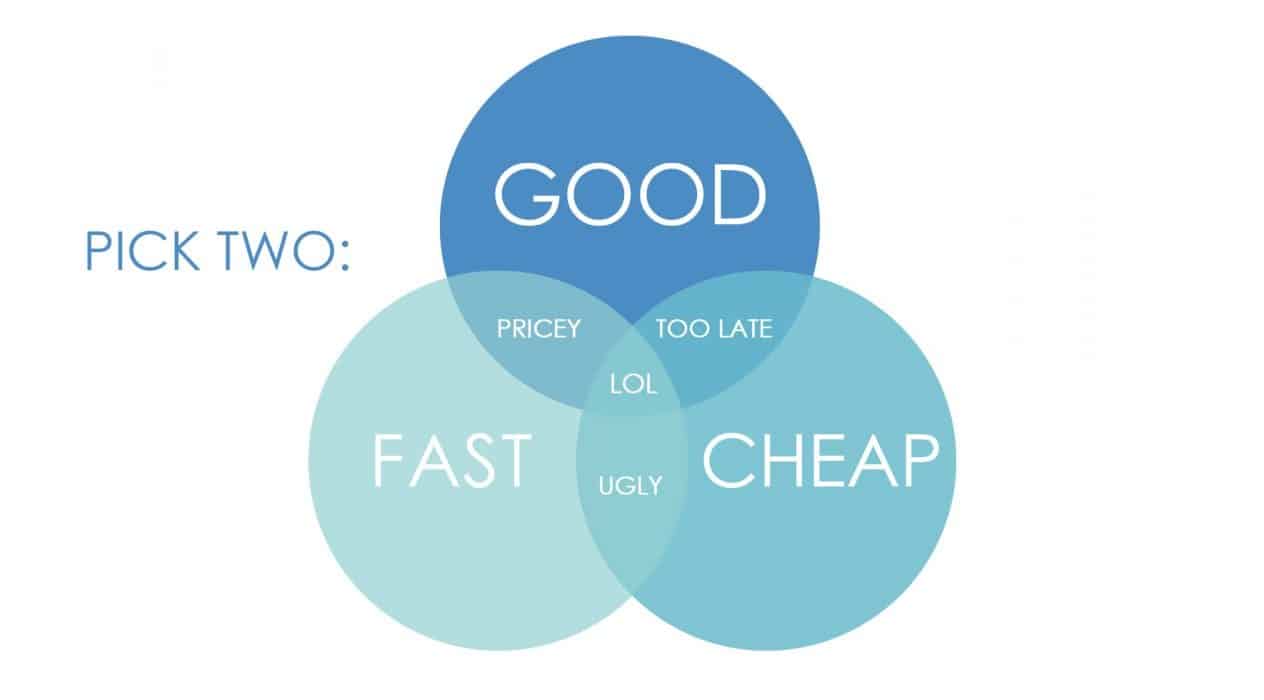
    See the figure above. I have been told that with most things, we only get to pick two. And if the thing we’re cheapening is the mind and our ability to think, write or communicate, I worry that cutting out “good” means we’re stunting ourselves. 

    There’s a balance here, tech and innovation can support the work without sacrificing skill for convenience. I am ten-toes-down on speaking and thinking for ourselves. 

    But as more and more people, more and more executives turn to AI for seemingly everything: advice, contracts, captions, even pitches, I worry that a good pitch is going to become a needle in a slop bucket. 

    What do you think? This is for sure my hottest most timely take yet. Standing on business. 

    Chat soon, 

    Sarah

  • If Everyone Else Was Jacking A Trend, Would You?

    If Everyone Else Was Jacking A Trend, Would You?

    It gets me every time. I’m scrolling, minding my business, when my heart jumps the second I see a notes-app screenshot from a brand. Except lately (albeit, I wrote this when the trend was actually trending), these aren’t confessions or apologies, but ads. They’re selling us stuff. Ew.

    Then there’s the posts that are “mistakes” made by “interns,” the posts where the brand calls me their “bestie,” the posts where I am led to believe that I am seeing something internal, something I shouldn’t as an external public. Aimed at my attention to stop the scroll and sell us stuff. Ew. 

    I’m not hating the game. Finding creative ways to pitch products is literally my job. But there is something so painfully inauthentic, so ick, about brands jumping on trends just to do it. There’s a difference between brands having a conversation with their audience and brands jumping into a conversation for clout.

    To get more perspective, I turned to internet big sis and Sorella Creative founder, Sophie Hunter. Another huge fangirl moment. Her posts and annual social calendars are fabulous and if you’re not following her, wyd??

    What are your top-level thoughts on brands/companies jumping in on social trends?

    “At their best, brands jumping on trends can feel like they’re part of the internet with us (not just talking at us). It shows cultural awareness, agility, and a genuine understanding of how communities behave online. Buuuut at their worst, it can feel rushed, forced, or like a brand trying on an identity that isn’t theirs. Trends move fast, and not every brand needs to chase every moment. Sometimes the smartest move is sitting it out.”

    Social gives brands instant access to engaged audiences. We all know that. We also know “just because you can doesn’t mean you should,” and yes, the classic “would you jump off a bridge just because all your friends are doing it?”

    Brand FOMO is real. If they’re not on socials and not “engaging,” they lose, right? But I get the ick when I see a clothing store acting like a college student leaked a mediocre sale in the middle of holiday season. Strip away the trendiness and the “everyone else  is doing it” FOMO: it’s ineffective promo. I’ll stop scrolling, sure, but I won’t convert. At best, it’s an inauthentic miss. At worst, it looks scammy. Or late. Or cringe.

    We’re all talking directly to our publics. But would you talk to them in the same tone everyone else uses  just because everyone else is using it? Sometimes skipping a trend is protecting the relationship.

    So I’m taking it back to those school assemblies on cyber safety they made us sit through in the mid-2000s/early-2010s: THINK before you post.

    What are some questions brand SMMs should ask themselves before hopping on a trend?

    “I always come back to three things:

    • Does this make sense/is it relevant for our brand voice and audience?
    • Would we still post something like this if the trend wasn’t “performing” right now?
    • Are we actually adding anything to the conversation or just echoing what others are doing/saying?
    • …Oh and bonus question if you pass the above… can we actually get this turned around quick enough for it to be timely (e.g. content creation, resource, legal sign off etc).”

    Not every brand has to be our best friend. I’m perfectly fine with a paper towel brand not calling me “bestie.” Sophie’s point stands: if you’re not adding to the conversation, does it even make sense to post? When brands are bandwagoning and pushing out the same slop, even if it’s engineered to catch the attention of my lizard brain, it’s inauthentic.

    Timing also matters. I think often about the meetings, Slack threads, approvals, edits, and sign-offs it takes to get a single post out the door. Momentum can build, stall, or die entirely. There’s no point in jumping off that bridge a full week after your friends did, especially if you hate swimming.

    So, let’s get to the bottom of this: 

    Why do you think brands jumping in on trends sometimes feels inauthentic or cringey?

    “Because audiences are way better at spotting when something isn’t genuine than we usually give them credit for. When a brand that’s never been playful suddenly tries Gen-Z humour, or when a serious brand jumps on a meme without context, it can feel kinda jarring. Inauthentic trend-jacking often happens when performance is prioritised over personality. The brands that pull it off best aren’t chasing relevance. They already know who they are.”

    Yep. Enough said. Proactive PR matters, but not if it doesn’t fit the client. If you know your brand, you know when to sit out the bridge-jumping.

    But honestly, could you look your boss in the eye (or the inbox) and say you’re skipping a trend because it’s cringe? I could, but LVPR has a main pillar of authenticity.

    What do you think? What trend do brands butcher the most? Have you ever jumped on a social wave and instantly regretted it? Spill.

    Chat soon, 

    Sarah

  • A Return to (Long) Form

    A Return to (Long) Form

    …And we’re back on my unending quest to understand Substack. My nightly routine now revolves around reading often melodramatic personal essays from eloquent 20-somethings. My very dorky PR-heart lit up when I scrolled upon a whole community of comms/media girlies getting in on the action. I feel more connected with my general domain in my Substack circles than I ever do on my overly-optimized LinkedIn

    So. I’m Humbled and honored to announce that I got to chat with Recovering Girlboss Juliette Dallas-Feeney (IG: @juliettedallasfeeney ) who’s also a brand consultant, media mogul, and Substacker. Her publication is as relatable as it is insightful. As a younger PR pro with high (very high) ambitions I find her work incredibly salient.

    I kept my questions simple because I wanted to get to the core of it: why do this? As Ali has said, PR is traditionally a “behind-the-camera” career, but in the social media age, a platform like Substack feels like a sanctuary  for media pros to take center-stage and connect.

    What drew you to Substack, and why now?
    “I was an early adopter of Substack, back when it was simply a newsletter-sending app and not yet the ecosystem it’s become. I wrote a few entries for my first Substack in 2023 about using cannabis as a kind of modern ritual and tool for creativity. But I felt like I needed to widen the aperture and create a space that gave me more space to play. So I created Recovering Girlboss, a space to explore ambition, identity, beauty, and digital culture with a little more honesty and context.

    After spending 15+ years shaping storytelling for media companies, tech startups, and beauty brands, I wanted a medium that allowed for more depth and nuance. Beauty, to me, has always been a mirror for culture: how we construct identity, how we perform selfhood, and how we express care. Substack gives me a place to write about those intersections — where discovery is guided by connection and curiosity, not (at least yet) by algorithmic noise.”

    There’s something magical about Recovering Girlboss and other pubs like it. It speaks the Substack language while still capturing the personality of its author. As media and comms pros, we’re used to tailoring messages to fit each channel. But as social media gets noisier, Substack feels like a sanctuary.

    Behind the camera or not, PR has always been about relationships. How we maintain those relationships has changed (a great idea for another column). But in an age where curiosity now feels rare online, feeds are hyper-tailored, echo chambers cycle the same things repeatedly and the mystique of the algorithm reigns supreme, Substack can be a return to a vaguely familiar, long-form space where media pros can thrive with room for depth and fully thought-out ideas.

    Which leads me to my next question…

    What do you feel it offers you as a creator/media pro?
    “It reminds me of the early days of blogging! Before social media shortened our attention spans and optimized every thought for engagement. Writing was my first love, and Substack makes space for that again. I’m drawn to how Substack offers a way to lead with ideas, to own your audience, and to use long-form writing as the creative foundation that everything else can ladder back to.”

    I’m too young to have lived through the true blogging era, but I totally see the potential within slowing down and lingering on an idea. Analog has been kinda trendy lately, it’s refreshing to read and write something that follows a thought to its natural conclusion.

    Unlike the blogging era, today’s internet runs on niches. I’ve got my comms circle and a digital playground built just for me. The platform’s always happy to keep the content coming. 

    Good for community? Absolutely. Good for our attention spans? Debatable. But it plays perfectly into the attention-scarce economy we’re all trying to outsmart.

    What’s the value or purpose you hope to bring to your readers through it?
    “Recovering Girlboss is my way of processing what it’s meant to spend my entire career inside the social media ecosystem, as both a participant and an observer. I’ve been online since the earliest days of brand social, and I’ve watched every shift in how we perform identity, seek validation, and measure worth. I’m interested in unpacking those paradoxes — what it means to be both the creator and the audience, the seller and the sold-to — and helping readers reclaim their attention so they can engage more consciously with the culture we’re all part of.”

    And there you have it, folks. I wholeheartedly agree and LOVE when media pros get on Substack. 

    I forecast a hunger within the collective consumer for creative ideas. Not just snackable bites for social, but full-course cheffed-up conversations that build community and explore ideas deeply.

    The language of Substack — its culture, tone and norms — feels incredibly timely. In an age of AI, short-form content, and convenience culture, a platform that values language, thought, and connection is only going to grow in demand. 

    But what do you think? Do you find yourself craving more from your media? Do you see yourself living out your writer fantasy in a newsletter of your own? 

    Chat soon, 

    Sarah

  • Who (or What) Is a Substacker?

    Who (or What) Is a Substacker?

    Growing up in the digital age, I’ve seen the rise and fall of social media platforms past: MySpace, Vine, Google+, BeReal (not dead yet, but basically). New social media sites aren’t rare, but ones that stick are. 

    Simply put, Substack is sticking. My gut reaction is to keep a finger so tight on the pulse, I can feel when someone’s affiliate link gets another cookie. Bump-bump: there goes someone’s brand partnership just made enough to pay my rent.

    Still, I find it somewhat hard to respond to the question “what even is Substack?” The platform right now feels like a funky Frankenstein of traditional media and social media both in its features and its users. As more writers, journalists, influencers, and everyday users flock to Substack, a more compelling question might be: What is a Substacker? Is it a writer? An influencer? A journalist? Who came first, the affiliate or the newsletter?

    To get some perspective, I asked the wonderful Abby Isaacson of Two West MGMT,, who manages several influencers with notable Substacks. (We’ve had the pleasure of working with Abby and her team on a traditional campaign before and it was lovely.)

    Thinking about the number of talent on your roster publishing on Substack today, do you see that number growing?

    “I expect that number to grow as Instagram and TikTok algorithms become more and more unpredictable, while Substack offers talent a more consistent path to reaching their core audience.”

    I agree, and want to circle back to that chicken-and-egg question. Maybe it doesn’t matter who came first, as long as creators find their niche and use the platform intentionally.

    Is Substack something you actively encourage your talent to participate in? Why? 

    “It depends on the creator’s goals, but generally, yes. Substack rewards consistency and enables creators to build paid communities with minimal barriers to entry.”

    True. Just because you can doesn’t mean you should. Influencers are often blamed for the decline of traditional media, so on a platform that merges both worlds, a little selectivity goes a long way.

    When it comes to affiliate, do you approach it like a standard influencer campaign, or does it function differently on Substack?

    “We don’t treat it like a standard campaign; there’s significant room for creativity in how affiliate links are integrated. Substack, in particular, has proven to be a strong revenue driver for affiliate partnerships in creators’ newsletters. We’ve found that collage-style product roundups and affiliate links embedded within storytelling content can be highly effective, often driving stronger conversion rates than other platforms.”

    Here’s where my (very biased CPG publicist) heart lit up. Product recs landing straight in the inbox? Yes, please. And if conversion is high, there’s every incentive to keep reading and scrolling and clicking.

    So maybe the real story isn’t about what Substack or who a substacker is, but what they’re becoming. The platform’s potential is undeniable, and it sounds like influencers are already on board. Whether you’re a writer, influencer, or just a nosy PR gal like me, Substack’s the new scroll worth studying. Because if the inbox really is the new feed, I, for one, want front-row seats. 

    See you soon,
    Sarah